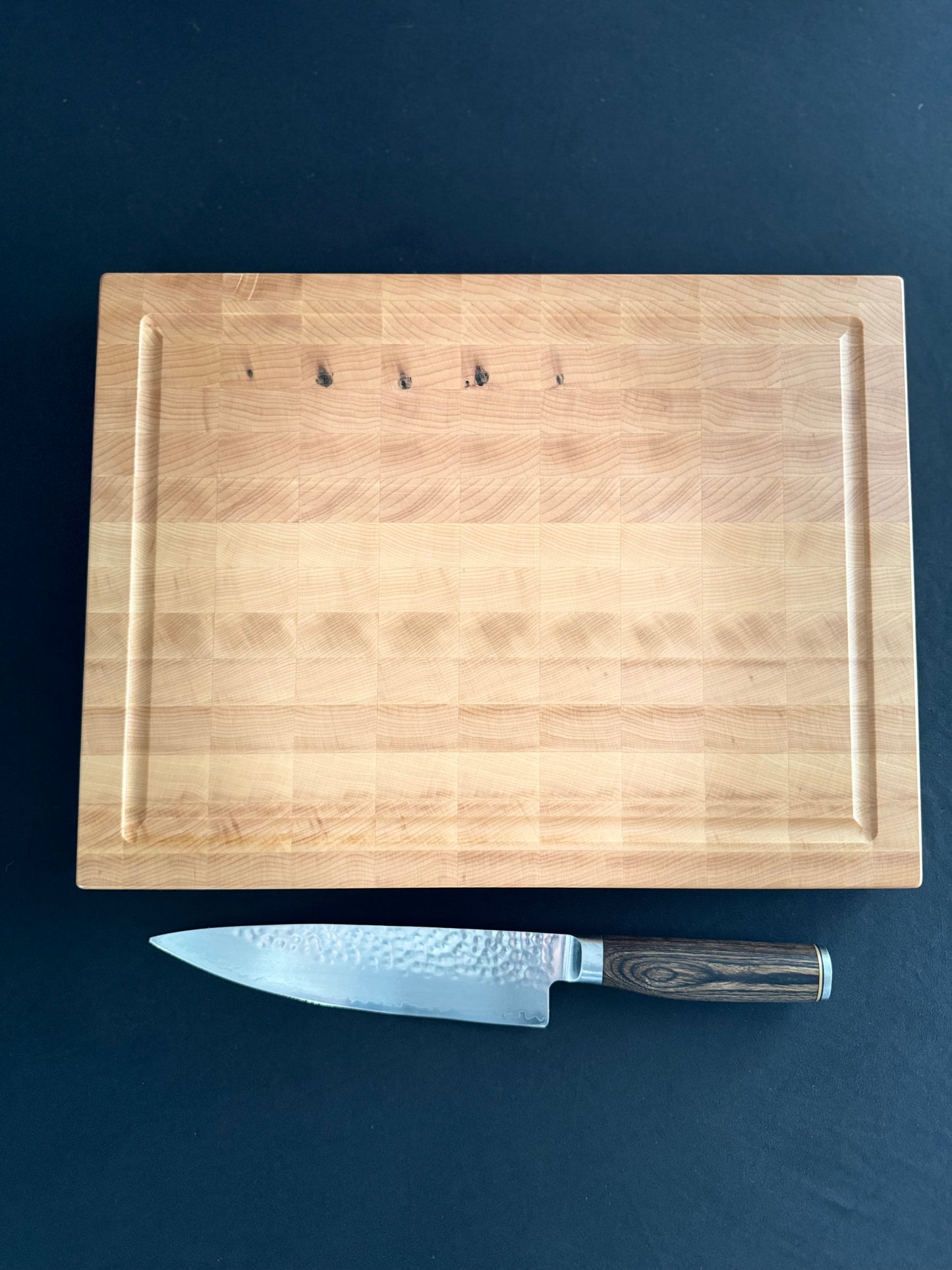
"LANGFORD" MAPLE END GRAIN CUTTING BOARD

Couldn't load pickup availability
- Size: 12 X 16 X 1 1/2
- Construction: End grain
- Material Info: Learn more about our material
- Approx. Weight:
The best thing for your board is beeswax. Period.
- Hand wash with moist cloth — never allow under a running the tap or put in the dishwasher
- Dry immediately and store standing upright for airflow on both sides
- Oil every 4–6 weeks with food-grade mineral oil or beeswax
Can I request custom sizing?
Yes, we always do our best to accommodate and we frequently make custom sized products. If you require a custom sized product, we encourage you to drop us a line via "contact" in the header.
Do you offer engraving?
Yes! We offer a fully customizable laser engraving option with most of our products.
Do you ship across Canada?
Yes! We ship to every province in Canada, however, different shipping rates may apply, depending on the province.
See more here →How long does production take?
We have a 15-17 day window to fulfill orders, as everything is made to order, and often placed in an order queue. If your item/s can be made and shipped sooner, they will be!
How often should I oil my board?
You should oil your board when your board begins to look "dull" or "flat". If water has stopped beading on the board, this may also be a sign your board needs oil. NOTE: Dish soap is purposely manufactured to dissolve oil / grease.
Read the care guide →What kind of glue are you using on your products?
We use Tite Bond III for all the products we make. It is an industry standard glue that is both reliable and food safe.
What finish do you use on your boards?
All our products are finished with a food safe mineral oil & beeswax.
See more here →What is the difference between Edge Grain & End Grain?
Edge grain and end grain boards are both durable hardwood cutting boards, but they are constructed differently.
Edge grain boards are made by gluing long strips of wood together so the edges of the boards form the surface. This creates a smooth, linear grain pattern. Edge grain boards are very strong, slightly lighter, and typically more affordable while still being excellent for everyday food preparation.
End grain boards are made by turning the wood blocks so the end of the wood fibers faces upward. This creates the checkerboard-style appearance often seen on butcher blocks. Because the knife cuts between the wood fibers rather than across them, end grain boards tend to be more knife-friendly and self-healing, meaning they show fewer visible knife marks over time.
Both types perform very well in the kitchen, but end grain boards are often considered the more "popular" option due to their visual appeal.